

It never stopped, the chanting was continuous, all encompassing, eternal, as in God’s own image. They are called the Acoemetae, the sleepless ones, and they aren’t your average old normal monks.
THE LAUS PERENNIS
Time, my friends, is not easily described. The more we know about it, the less we know of it. For the aboriginals, time as a concept did not even really exist. For them it lives as much in man’s collective imagination as does Winnie The Pooh. So how then did this beast finally succumb to the will of man? Did we frame time and with it, tame it as well? Or did time enslave us to its will? Let’s dive in to the sea of time and see which creatures therein lurk.
Let us start with Alexander. Now here is a man with a serious set of ye old cojones. It is recorded that this man set out, off into the desert, to convert some hardened desert hoodlums and robbers into christianity. ‘Hey crooks and robbers! Have you heard about Jesus?’ He actually came back out of the desert with a good three to four hundred followers. Thusly the Acoemetae were founded around 400AD. Alexander, bold as ever, then went on and took his newly found Christians back into his native, and not incredibly Christian, Constantinople, where they were in turn driven out. Shocking, I know. They then went on and got themselves settled into a real monastery at the Black Sea, in Gormon. This is where they got serious about praising the Lord and his dominion over this world. The practice was named eternal praise and you’re probably going to want to fact-check me later, I’m sure.
These monks sang their praise to God non-stop, 24/7. Of course one person could not sing indefinitely, so the monks were divided into six rotating choirs, each one relieving the other. In a way they literally embodied God’s time by singing praise throughout it continuously. Their bodies became God’s clockwork, each breath a second, each exhale a note to mark time passing. They continued their eternal praise from the fifth century on until somewhere in the 1960s. That, ladies and gentlemen, is a solid 1,445 years of singing without ever stopping. Ludicrous. As a potential direct result, one of the French Benedictine monasteries (no relation to eggs Benedic t) collapsed of fatigue. It seems time finally caught up with them.
GOD OWNS TIME
Friends, the hour is upon us. I mean that quite literally. The medieval day was divided into eight canonical hours for the same reason as with the eternal praise, to mark the times at which monks were required to pray. Matins, Lauds, Prime, Terce, Sext, None, Vespers, Compline. The monastery bell announced each one. The city organised itself around it. People did not own clocks. God owned time and the Church administered it through sound. This sound had a name long before it had a tower. The word bell comes from the Old English belle, likely from Proto-Germanic balljo, to roar, to bellow. The same root that gives you the bellowing of an animal, the belly that resonates, the ball of sound expanding outward. A bell does not ring. It roars. It seems we tried to domesticate the word the same way the Church tried domesticating the thing. Noon, as in midday, comes directly from None, for ninth hour. Originally this was around 15h in the afternoon, the ninth hour after sunrise, but for a plethora of potential reasons it drifted earlier and earlier and became our lunchtime.
As the Church tried to structure society through time and domesticate its flock thusly, the human spirit reared its beautiful, artistic head. The importance of punctual prayer in medieval Europe is not to be understated. Some of you might still express your faith through routine prayer till this very day and understand what I mean. If you were out and about toiling in the fields and you missed two strikes of the bell, or was it three? You see, people needed to know when to start counting. Didn’t pay attention and you might well tick off God. So something named a quatrion (for Latin quaternionem, four times) was installed. A set of four distinct different bells that would ring before the hour, so everybody got a heads-up. All in the name of giving structure to society, music accidentally was born.
THE CARILLON
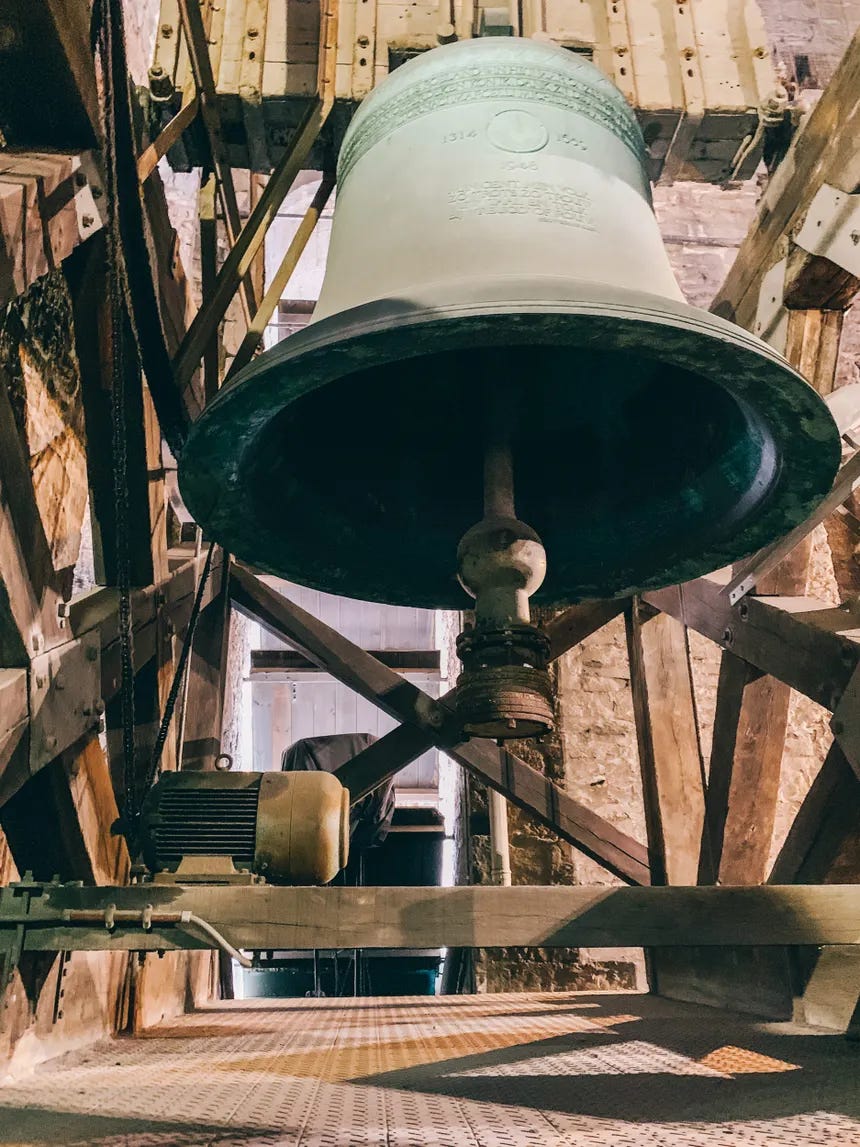
Bells, by their very nature, are beautiful. When they ring, our souls resonate. The quatrion evolved into what we today call a carillon. The original quatrion were four stationary bells, hung high up in the tower, struck by a mechanical hammer, triggered by the same mechanism that moved the clock hands. The clock told time, the bells announced it, and the four pitches together formed the quatrion.
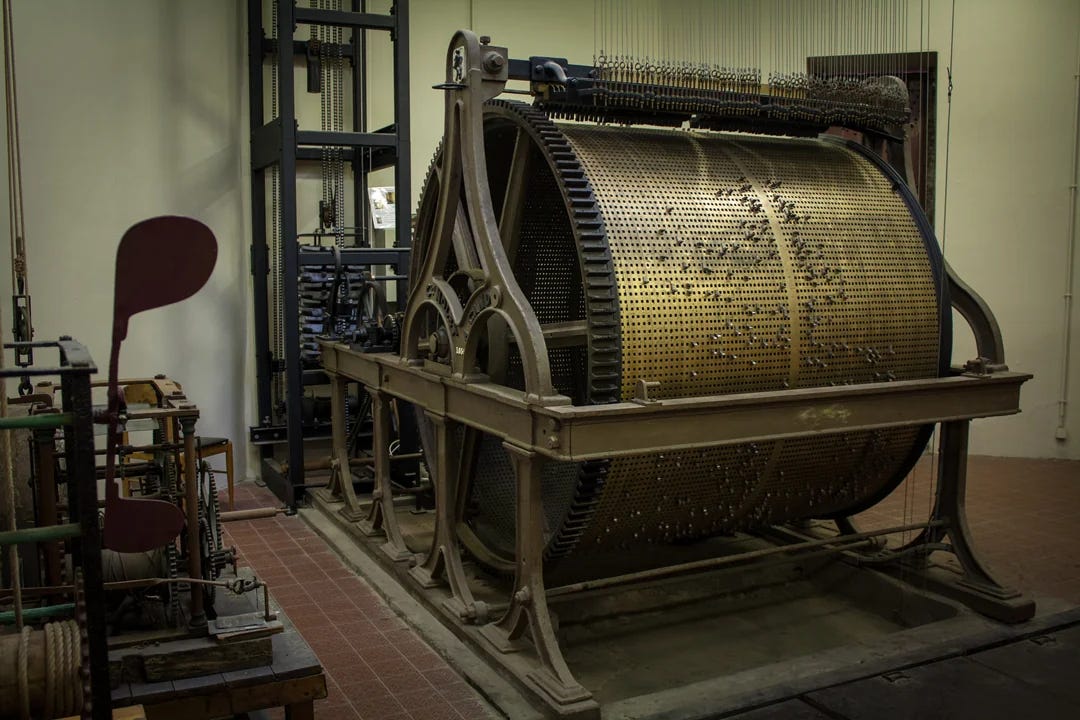
Functional yay or nay, the sound was mesmerizing. Bell makers started fooling around with pitches. More bells were added. Still mechanical, still clock-driven, still automatic. But now the mechanism had a barrel, a large rotating cylinder studded with pins, each pin triggering a specific bell at a specific moment. The same principle as a music box, scaled up to the size of a tower room. You programmed the melody by repositioning the pins. The church tower had become, without anyone quite deciding this, a programmable instrument.
Then came the keyboard. The clavier. A manual console of wooden levers, each one connected by a wire to the clapper of a specific bell. Now a man sat inside the tower and played. Not with his fingers, the levers were too stiff and heavy for that, but with his fists and feet, striking the keys with the padded side of his hand, operating the largest bells with foot pedals below. The physical effort was considerable. The carillonneur did not sit at his instrument so much as wrestle with it.
By 1480, somewhere in Flanders, possibly Aalst or Antwerp, the carillon had grown to somewhere between twenty and thirty bells, spanning two octaves, enough range to play actual music. Recognisable melodies. Things people knew. The same tower that told you when to pray was now playing you music from the skies and heavens, quite literally.
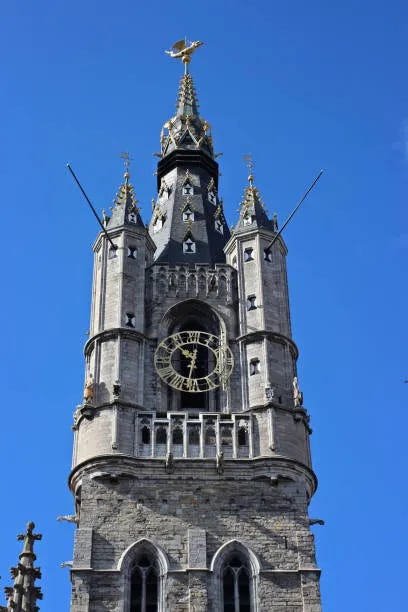
Mechelen made it official in 1557, appointing the first municipal carillonneur. A civic employee. A musician on the city payroll. The instrument kept growing. A full modern carillon has anywhere from forty-seven to seventy-seven bells, spanning four to six octaves, the largest bells weighing several tonnes, the smallest the size of a teacup. The biggest bell in the Ghent carillon weighs over six thousand kilograms. You can hear it from eight kilometres away on a still day.
And now we know, God owns time and through it, gifted us rock and roll as well.
PHILIP THE GOOD AND HIS LUGGAGE
Kobi One frequenters might be familiar with the Burgundians already. In my first episode of Chronicle of Crowns, I unravel the mystery of who the Burgundians were and I mention Philip the Bold, often called the Brave by yours truly, and his obsession with time. I did more research and have to set the record straight. It was his grandson, Philip the Good, who was obsessed with time. Now, seeing as they are all named either Philip or Charles, I ask humbly for your forgiveness.
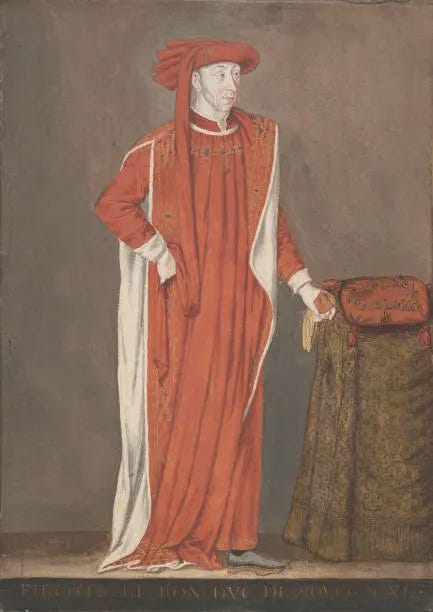
Philip the Good. Duke of Burgundy from 1419 to 1467, apparently put on a pair of embroidered scarlet leather slippers, hung his portable clock on the wall and went to sleep in a woollen nightcap. If he went out, he brought his clock with him. That clock would be the Burgunderuhr, the Duke of Burgundy clock, made around 1430. It is the oldest surviving spring-driven clock in the world. It is shaped like a Gothic cathedral, made for Philip the Good, and features the Burgundian lion coat of arms on two surmounting spires and the symbol of the Order of the Golden Fleece.
He was both extremely religious and absolutely captivated by the future. He kept with him at all times, together with the clock, his Book of Hours, a lavishly illuminated manuscript structured around the eight canonical hours, the same hourly divisions of our sleepless ones. Philip the Good carried God’s time in a book in one hand and his own mechanical time on the wall in the other. He was hedging. A man smart enough to keep one foot in the old world while building the new one.
His obsession with the future resulted in him and me sharing a fascination, one for automata. The party of the century was hosted in 1454, in modern day France, Lille, by none other than Philip the Good and his son, Charles the Bold.
The Feast of the Pheasant was one of the most spectacular banquets in medieval history, with automata, mechanical sculptures driven by hydraulic and mechanical systems, providing entertainment between courses. Moving mechanical figures at a dinner table in 1454. This man had the world’s first clock and robots? Go on, fact-check me by now.
Time moved from the towers of God into the hands of men. The corset of time that the Church was dressing civilisation in changed hands, seemingly overnight.
THE CORSET OF TIME
The aboriginals did not believe in time. A society built around the eternal now seems something beautiful, somehow. Yet I sincerely do not know how it would look. Time dictates our society. We live in a world where we can predict the arrival of a bus within actual minutes. The sheer cooperation and human predictability needed to achieve that amount of timing and accuracy is absolutely astounding. But all of that cooperation and effort is dictated by time. So who dictates time, dictates society. He who tailors the corset of time, can tailor society to their will.
And I am left to wonder if there could really be such a thing as man dictating time, controlling it, or if I just summarized mankind’s hubris and folly or potentially mine own? We went from the monks singing their eternal praise to smartphone algorithms nudging our behaviour as we nudge theirs and did we gain any real control in the process?
A moment or two these thoughts plague me and soon as they showed, they were defeated by a grander thought altogether.
Whilst the Church and the dukes were seeking to control time and prayer, the builders out there, the creatives out there, were doing what mankind does best: fool around until something cool happens.
The Church installs bells to ring out God’s time, medieval engineers come up with the idea for the quatrions so everybody can actually follow. The artisans start building an instrument out of it. Man tries to tame time, reinvents music and loses control of both time and music in the process.
Time and time again, man tries to steer the world. And we usually succeed too. We just never end up where we thought we would.
THE ESCAPE
The bells of God ring out and strike a chord in the hearts of men. So too, the hearts of men and women in taverns, where the bells start finding the hurdy gurdy and the lute to accompany them. People’s emotional response to the sounds resonating within their souls finds a way to their legs and arms and we rejoice. Song and dance, rediscovered and reinvented once more. And so God’s voice escapes the compound and resounds distorted through medieval rock and roll. This was no longer God’s work. A new player enters the game. God’s music released becomes uncontrollable, ungovernable, chaos released, the Devil takes control.
To punish the harbingers of doom, an apt description of musicians, Hieronymus Bosch puts every musician in hell in his masterpiece The Garden of Earthly Delights, aka De Tuin der Lusten. I will refrain from entering his awesome hellscape during this article though one detail stands out, the butt music. Marks painted on a sinner’s backside in the hell panel, transcribed in 2014 and posted online as the 500-Year-Old Butt Song from Hell. It went viral. Scholars confirmed Bosch never intended the marks to be readable music. It is the appearance of notation, not actual notation. The internet decided it was real anyway.
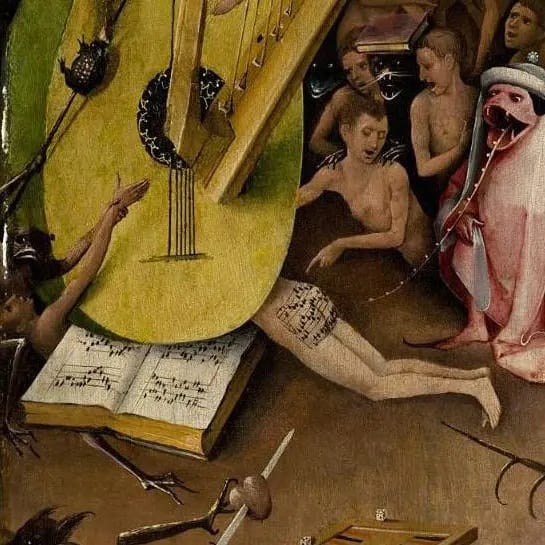
Time made its sweet escape from the church into people’s pockets and with it, convinced music to escape into people’s hearts. The door through which they departed was left as an open invitation to the Devil himself.
Let’s find out what he has to say on the matter,
in the next Strange Origins.
See you there.


